Thermal shipping labels are essential tools for eCommerce sellers, warehouses, logistics companies, and retail businesses. However, one question frequently arises when choosing labels:
Should you use continuous roll labels or fanfold thermal labels?
Both formats are widely used and fully compatible with many popular direct thermal printers. However, each type has its own advantages and ideal applications.
Understanding the differences between continuous roll labels and fanfold labels can help you improve printing efficiency, reduce downtime, save storage space, and optimize your overall shipping process.
In this guide, we’ll compare continuous roll and fanfold thermal labels in detail and use Betckey thermal labels as the benchmark to help you determine which option is best for your business.
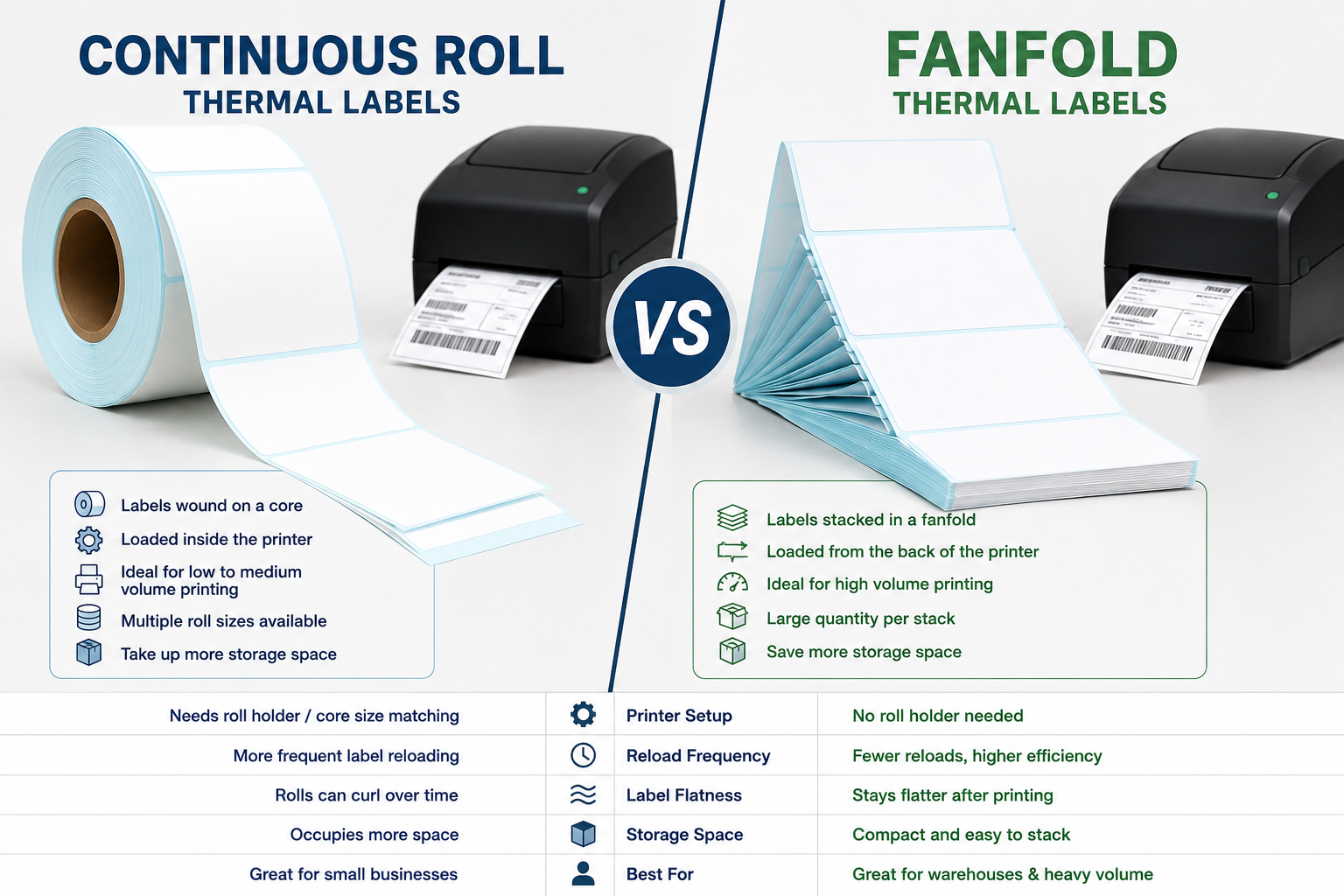
What Are Continuous Roll Thermal Labels?
Continuous roll thermal labels are the most traditional format used in direct thermal printing.
The labels are wound around a cardboard core and supplied in roll form. They are designed to feed continuously through the printer and are commonly used with desktop and industrial thermal printers.
Betckey offers continuous roll labels in various sizes and core diameters, including:
- 4″ x 6″ shipping labels
- 4″ x 5″ labels
- Barcode labels
- Inventory labels
- Address labels
These labels are compatible with many popular printers, including:
- Zebra
- Rollo
- Brother
- MUNBYN
- Jadens
- POLONO
- iDPRT
- K Comer
Continuous rolls are one of the most popular choices for businesses of all sizes.
What Are Fanfold Thermal Labels?
Unlike roll labels, fanfold labels are stacked in a zigzag pattern instead of being wrapped around a core.
The labels are folded into a compact stack and feed through the back of the printer.
Betckey fanfold labels are commonly available in:
- 4″ x 6″
- Shipping labels
- Warehouse labels
- Barcode labels
Fanfold labels are particularly popular among:
- Amazon FBA sellers
- Shopify stores
- eBay sellers
- Etsy businesses
- High-volume shipping operations
Their unique design offers several advantages over traditional roll labels.
Continuous Roll vs. Fanfold Thermal Labels: Understanding the Main Differences
Although both formats produce identical print quality, their physical structure creates important differences in usage.
Label Storage
Continuous Roll Labels:
- Stored on a cardboard core.
- Require cylindrical storage space.
- May occupy more shelf volume.
Fanfold Labels:
- Stored in flat stacks.
- Easy to organize.
- Save storage space.
For businesses with limited workspace, fanfold labels often have an advantage.
Printer Feeding Method
Continuous Roll Labels:
- Loaded inside the printer.
- Feed directly from the roll.
- Require proper core size compatibility.
Fanfold Labels:
- Feed externally from behind the printer.
- Do not require internal roll holders.
- Eliminate concerns about maximum roll diameter.
Both methods are reliable, but the setup process differs.
Continuous Roll vs. Fanfold Thermal Labels: Print Speed and Efficiency
Many users wonder whether one format prints faster than the other.
In reality, print speed is primarily determined by the printer rather than the label format.
Betckey labels are manufactured with premium direct thermal coatings that support high-speed printing for both roll and fanfold configurations.
However, fanfold labels offer one efficiency advantage:
Fewer Label Reloads
Large stacks of fanfold labels often contain:
- 500 labels
- 1,000 labels
- 2,000 labels
- 5,000 labels
This reduces interruptions caused by changing rolls.
For high-volume fulfillment operations, fewer reloads mean:
- Increased productivity
- Less downtime
- Faster order processing
Continuous Roll vs. Fanfold Thermal Labels: Storage Space Comparison
Storage efficiency becomes increasingly important as order volume grows.
Continuous Roll Labels
Roll labels are compact but cylindrical.
Multiple rolls can occupy:
- Drawers
- Shelves
- Storage bins
The cardboard cores and circular shape can make stacking less efficient.
Fanfold Labels
Fanfold labels lie flat.
Advantages include:
- Easy stacking
- Better organization
- Efficient warehouse storage
- Less wasted space
Many Amazon FBA sellers prefer fanfold labels because they can store thousands of labels in a relatively small footprint.
Continuous Roll vs. Fanfold Thermal Labels: Printer Compatibility
Both label formats are compatible with most direct thermal printers.
Betckey labels are compatible with:
Zebra Printers
- ZD220
- ZD421
- ZD621
Rollo Printers
- Original Rollo
- Rollo Wireless Printer
Brother Printers
- QL-1100
- QL-1110NWB
MUNBYN Printers
- ITPP941
- RW402B
Jadens Printers
POLONO Printers
iDPRT Printers
K Comer Printers
Roll labels generally work best with printers that contain internal roll compartments.
Fanfold labels are ideal for printers with rear-feed slots.
Fortunately, many modern printers support both formats.
Continuous Roll vs. Fanfold Thermal Labels: Which Is Better for High-Volume Shipping?
Businesses shipping hundreds or thousands of packages daily prioritize efficiency.
Continuous Roll Labels Advantages
- Simple loading
- Widely available
- Familiar to many users
- Excellent for medium-volume operations
Fanfold Labels Advantages
- Large stack capacities
- Reduced reloading frequency
- Less downtime
- Better for continuous printing
For Amazon FBA sellers and warehouses handling large order volumes, Betckey fanfold labels often provide superior workflow efficiency.
Continuous Roll vs. Fanfold Thermal Labels: Which Is Better for Small Businesses?
Small businesses have different priorities.
They often value:
- Simplicity
- Convenience
- Lower upfront investment
- Compact equipment
For businesses shipping:
- 10 packages per day
- 20 packages per day
- 50 packages per day
Betckey roll labels are often the preferred choice.
Benefits include:
- Easy setup
- Internal loading
- Minimal workspace requirements
- Familiar operation
As order volume grows, many businesses eventually transition to fanfold labels.
Continuous Roll vs. Fanfold Thermal Labels: Label Waste and Curling
Another difference between the two formats involves label behavior.
Roll Labels
Because labels are wrapped around a core, they naturally retain some curvature.
Occasionally this can result in:
- Slight curling
- Difficulty lying flat immediately after printing
Betckey labels are designed to minimize curling, but the effect is still inherent to roll construction.
Fanfold Labels
Since they are stacked flat, fanfold labels:
- Stay flatter after printing
- Are easier to apply to boxes
- Improve application speed
For high-speed fulfillment environments, flatter labels can slightly improve productivity.
Continuous Roll vs. Fanfold Thermal Labels: Cost Comparison
Price differences between the two formats are usually minimal.
Betckey offers both formats at competitive factory-direct pricing.
Overall cost depends more on:
- Label size
- Quantity
- Material
- Adhesive type
In terms of operational costs:
Roll Labels
May require more frequent reloads.
Fanfold Labels
Reduce interruptions and improve labor efficiency.
Over time, this productivity advantage can offset any small differences in purchase price.
Continuous Roll vs. Fanfold Thermal Labels: Which One Saves More Space?
For businesses with limited storage space, fanfold labels usually provide better efficiency.
Benefits include:
- Flat storage
- Easier stacking
- Higher label counts per box
- Better warehouse organization
However, roll labels remain highly convenient for smaller offices and home-based businesses.
The ideal choice depends on:
- Shipping volume
- Workspace size
- Printer configuration
- Workflow preferences
Why Betckey Offers Both Continuous Roll and Fanfold Thermal Labels
Betckey understands that every business has different requirements.
That’s why Betckey provides both formats in premium BPA-free direct thermal materials.
Betckey labels feature:
- Strong permanent adhesive
- Crisp, dark printing
- BPA-free materials
- Excellent barcode readability
- Jam-free performance
- Wide printer compatibility
Whether you choose roll labels or fanfold labels, you receive the same premium quality and reliability.
Which Businesses Should Choose Continuous Roll Labels?
Continuous roll labels are ideal for:
- Home offices
- Etsy shops
- Small Shopify stores
- Low-to-medium volume sellers
- Businesses using printers with internal roll compartments
They offer simplicity and convenience while maintaining excellent performance.
Which Businesses Should Choose Fanfold Thermal Labels?
Fanfold labels are ideal for:
- Amazon FBA sellers
- Warehouses
- High-volume shipping departments
- Third-party logistics companies
- Growing eCommerce businesses
Their larger capacity and reduced downtime make them an excellent choice for demanding operations.
Conclusion
When comparing continuous roll vs. fanfold thermal labels, neither format is universally better. The right choice depends on your business size, shipping volume, available workspace, and printer setup.
Choose Betckey continuous roll labels if you value:
- Easy loading
- Internal storage
- Simplicity
- Compact desktop setups
Choose Betckey fanfold labels if you need:
- Higher label capacities
- Fewer reloads
- Better storage efficiency
- Improved productivity
Fortunately, both options provide the same high-quality print performance, strong adhesion, and reliable compatibility that businesses expect from Betckey products.
Frequently Asked Questions
Are fanfold labels better than roll labels?
Not necessarily. Fanfold labels are better for high-volume shipping because they reduce reload frequency, while roll labels are more convenient for smaller operations.
Do Betckey thermal labels come in both roll and fanfold formats?
Yes. Betckey offers both continuous roll and fanfold thermal labels in multiple sizes, including the popular 4″ x 6″ shipping labels.
Which format is best for Amazon FBA sellers?
For most Amazon FBA businesses with high shipping volumes, Betckey fanfold labels are often preferred because they hold more labels and reduce downtime caused by changing rolls.