When selecting labels for shipping, inventory management, product identification, asset tracking, healthcare, retail, or industrial applications, one of the most important decisions you’ll make is choosing between Direct Thermal Labels and Thermal Transfer Labels.
At first glance, both technologies may seem similar. They use thermal printers, produce high-quality barcodes, and eliminate many of the limitations associated with traditional inkjet or laser printing. However, the differences between these two labeling methods can significantly impact print durability, operating costs, maintenance requirements, and overall business efficiency.
For businesses looking to optimize their labeling operations, understanding these differences is essential. Whether you’re an ecommerce seller printing shipping labels or a manufacturer tracking products through harsh environments, selecting the right label technology can save both time and money.
In this guide, we’ll compare Direct Thermal Labels and Thermal Transfer Labels in detail, using Betckey thermal labels as the primary benchmark to help you determine which solution best fits your needs.
What Are Direct Thermal Labels?
Direct Thermal Labels are labels coated with a heat-sensitive layer that reacts when exposed to heat from a thermal printhead.
Unlike traditional printing methods, direct thermal printing requires:
- No ink
- No toner
- No ribbons
The printer applies heat directly to the label surface, causing the coated area to darken and create text, graphics, or barcodes.
This simple printing process is one reason why Betckey Direct Thermal Labels are popular among ecommerce businesses, warehouses, and shipping operations.
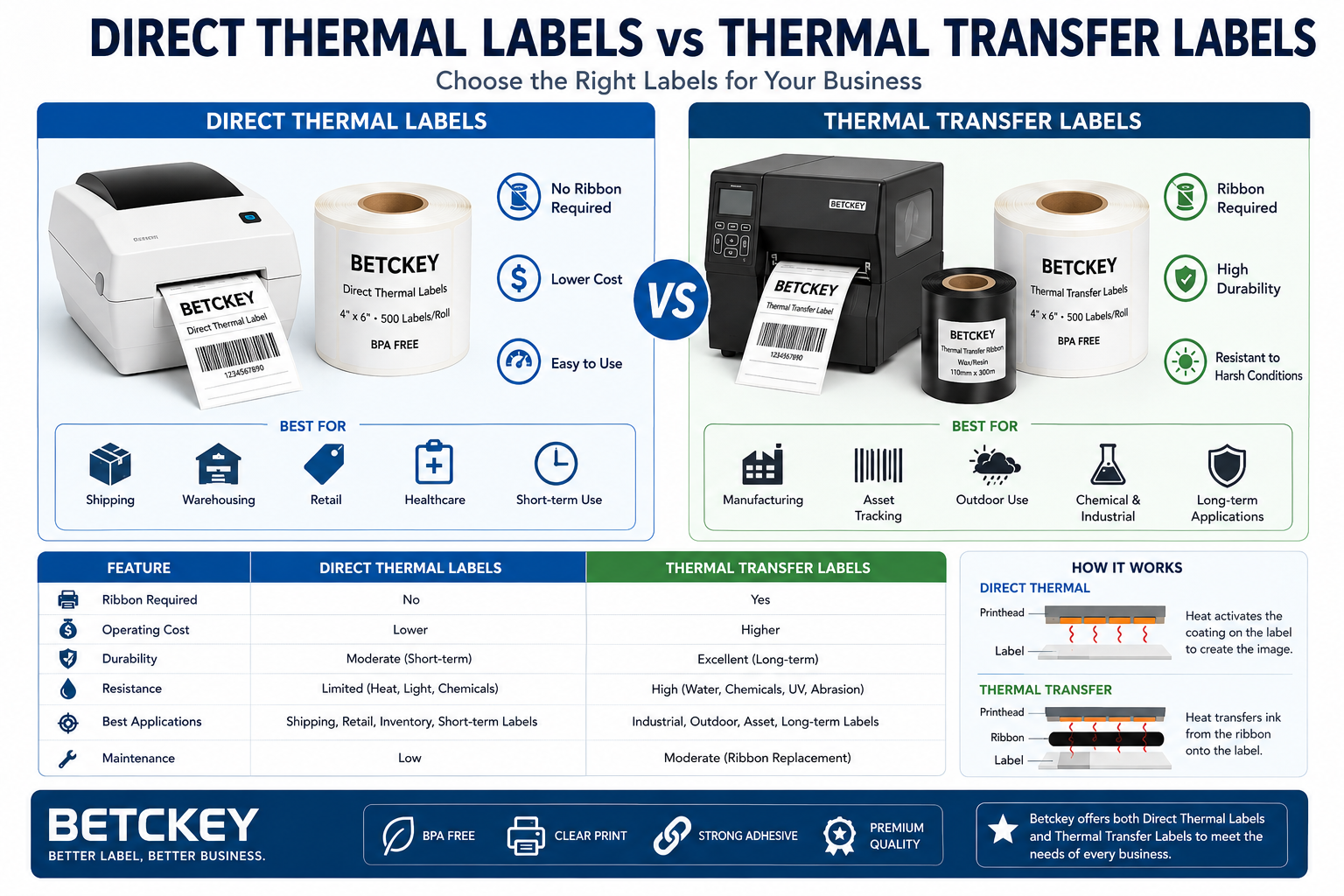
How Direct Thermal Printing Works
The process is straightforward:
- A thermal printhead generates heat.
- The heat activates the label’s thermal coating.
- The activated areas turn black.
- The image is permanently formed on the label.
Since no ribbon is involved, there are fewer consumables and fewer maintenance requirements.
What Are Thermal Transfer Labels?
Thermal Transfer Labels use a different printing method.
Instead of printing directly onto the label surface, the printer transfers ink from a ribbon onto the label.
The printing process involves:
- A thermal transfer ribbon
- A printhead
- A compatible label material
When heat is applied, the ribbon melts and transfers ink onto the label surface.
This creates a highly durable image that can resist moisture, chemicals, abrasion, UV exposure, and extreme temperatures.
How Thermal Transfer Printing Works
The process includes:
- A ribbon sits between the printhead and the label.
- Heat is applied to the ribbon.
- Ink is transferred onto the label.
- A permanent image is created.
This additional step increases durability but also introduces additional supply costs.
Key Differences Between Direct Thermal and Thermal Transfer Labels
Before deciding which technology to use, it’s important to understand how they compare across several key categories.
Printing Method
Direct Thermal
- Uses heat-sensitive label material
- No ribbon required
- Simpler printing process
Thermal Transfer
- Uses ribbon and label combination
- Ink is transferred onto the label
- More components involved
Winner: Direct Thermal for simplicity.
Initial Equipment Costs
Direct Thermal
Direct thermal printers generally cost less because they don’t require ribbon handling mechanisms.
Businesses can often begin printing immediately using Betckey Direct Thermal Labels without purchasing additional supplies.
Thermal Transfer
Thermal transfer printers are usually more expensive due to their ribbon management systems.
Winner: Direct Thermal.
Consumable Costs
Direct Thermal
Consumables include:
- Labels only
There are no ribbons to purchase, store, or replace.
Thermal Transfer
Consumables include:
- Labels
- Thermal transfer ribbons
Ribbon costs add up over time, especially in high-volume environments.
Winner: Direct Thermal for lower operating costs.
Print Durability
This is where thermal transfer technology shines.
Direct Thermal
Direct thermal labels are excellent for short-term applications but may be affected by:
- Heat
- Sunlight
- Friction
- Chemicals
Over time, labels can darken or fade.
Thermal Transfer
Thermal transfer labels offer superior resistance to:
- Water
- Chemicals
- UV exposure
- Abrasion
- Extreme temperatures
They can remain readable for years.
Winner: Thermal Transfer.
Print Quality
Direct Thermal
Betckey Direct Thermal Labels produce sharp text and barcodes suitable for:
- Shipping labels
- Barcode labels
- Inventory labels
- Address labels
Thermal Transfer
Thermal transfer printing often produces slightly sharper images, particularly for:
- Small text
- High-density barcodes
- Industrial labeling
Winner: Thermal Transfer for maximum precision.
Speed and Efficiency
Direct Thermal
Because there is no ribbon involved:
- Loading is easier
- Maintenance is lower
- Downtime is reduced
This makes direct thermal ideal for high-volume shipping environments.
Thermal Transfer
Ribbon replacement adds extra steps and maintenance.
Winner: Direct Thermal.
Environmental Conditions
Direct Thermal Labels
Best suited for:
- Indoor environments
- Controlled temperatures
- Short-term use
Examples include:
- Shipping labels
- Packing slips
- Retail receipts
- Temporary inventory labels
Thermal Transfer Labels
Ideal for:
- Outdoor environments
- Cold storage
- Manufacturing facilities
- Chemical exposure areas
Examples include:
- Asset tags
- Compliance labels
- Product identification labels
- Industrial tracking labels
Winner: Thermal Transfer.
Common Applications for Direct Thermal Labels
Direct thermal labels are widely used because of their simplicity and affordability.
Ecommerce Shipping
This is perhaps the most common use case.
Betckey 4″ x 6″ Direct Thermal Shipping Labels are frequently used by:
- Amazon sellers
- Shopify merchants
- Etsy sellers
- eBay businesses
Shipping labels generally have a short lifespan, making direct thermal printing an excellent solution.
Warehousing
Many warehouses use direct thermal labels for:
- Inventory tracking
- Bin labeling
- Picking operations
Retail
Retail businesses often use direct thermal labels for:
- Temporary shelf labels
- Price labels
- Internal inventory labels
Healthcare
Applications include:
- Patient records
- Prescription labeling
- Specimen tracking
When labels do not require years of durability, direct thermal remains the most cost-effective choice.
Common Applications for Thermal Transfer Labels
Thermal transfer labels excel when durability is critical.
Manufacturing
Manufacturers use thermal transfer labels for:
- Product identification
- Component tracking
- Compliance labeling
Asset Management
Equipment labels often need to remain readable for years.
Thermal transfer technology provides the required longevity.
Outdoor Labeling
Outdoor environments expose labels to:
- Sunlight
- Rain
- Heat
- Cold
Thermal transfer labels are designed to withstand these conditions.
Chemical and Industrial Applications
Industrial facilities often require labels that resist:
- Solvents
- Oils
- Cleaning agents
Thermal transfer labels offer superior resistance.
Label Materials Available for Each Technology
Direct Thermal Materials
Common materials include:
- Paper labels
- Premium coated paper labels
- Direct thermal synthetic labels
Betckey offers direct thermal labels suitable for shipping, warehousing, and ecommerce operations.
Thermal Transfer Materials
Thermal transfer systems support:
- Paper labels
- Polypropylene (PP)
- Polyester (PET)
- Vinyl labels
- Durable synthetic films
This versatility makes thermal transfer ideal for industrial applications.
Maintenance Considerations
Direct Thermal Printers
Benefits include:
- Fewer moving parts
- No ribbon management
- Faster media changes
- Lower maintenance costs
Thermal Transfer Printers
Require:
- Ribbon loading
- Ribbon replacement
- Additional cleaning
Although manageable, maintenance is generally higher.
Winner: Direct Thermal.
Which Option Is More Cost-Effective?
The answer depends on your application.
Choose Direct Thermal Labels If:
You need:
- Low-cost printing
- Shipping labels
- Short-term barcode labels
- High-volume operations
- Minimal maintenance
Betckey Direct Thermal Labels are often the most economical solution for ecommerce and logistics businesses.
Choose Thermal Transfer Labels If:
You need:
- Long-term durability
- Outdoor performance
- Chemical resistance
- Compliance labeling
- Industrial-grade identification
Although costs are higher, the increased durability often justifies the investment.
Direct Thermal vs Thermal Transfer: Quick Comparison Table
| Feature | Direct Thermal | Thermal Transfer |
|---|---|---|
| Ribbon Required | No | Yes |
| Ink Required | No | Ribbon Ink |
| Initial Cost | Lower | Higher |
| Operating Cost | Lower | Higher |
| Durability | Moderate | Excellent |
| UV Resistance | Limited | High |
| Chemical Resistance | Limited | High |
| Outdoor Use | Limited | Excellent |
| Shipping Labels | Excellent | Good |
| Industrial Labels | Limited | Excellent |
| Maintenance | Low | Moderate |
| Ease of Use | Excellent | Good |
How Betckey Helps Businesses Choose the Right Labels
At Betckey, customers can choose from a wide range of thermal labeling solutions designed for different industries.
For ecommerce and shipping operations, Betckey Direct Thermal Labels provide:
- Sharp barcode printing
- Strong adhesive performance
- BPA-free options
- Cost-effective operation
For customers requiring enhanced durability, thermal transfer-compatible label materials can support demanding industrial environments.
The best choice ultimately depends on how long the label needs to remain readable and the conditions it will face throughout its lifecycle.
Conclusion
Both Direct Thermal Labels and Thermal Transfer Labels offer significant advantages, but they serve different purposes.
Direct thermal labels are ideal for businesses that prioritize:
- Simplicity
- Low operating costs
- High-volume shipping
- Short-term applications
Thermal transfer labels are better suited for organizations that require:
- Long-term durability
- Outdoor performance
- Chemical resistance
- Industrial reliability
For many ecommerce sellers, warehouses, and logistics providers, Betckey Direct Thermal Labels deliver the perfect combination of affordability, performance, and convenience. However, when labels must survive harsh environments or remain readable for years, thermal transfer technology becomes the superior choice.
Frequently Asked Questions
FAQ 1: Do Direct Thermal Labels Require Ink or Toner?
No. Direct thermal labels use a heat-sensitive coating that reacts to heat from the printer’s printhead. No ink, toner, or ribbon is required, which helps reduce operating costs.
FAQ 2: Why Do Direct Thermal Labels Fade Over Time?
Direct thermal labels can darken or fade when exposed to heat, sunlight, friction, or certain chemicals. For applications requiring long-term readability, thermal transfer labels are generally recommended.
FAQ 3: Which Label Type Is Best for Shipping Labels?
Direct thermal labels are typically the best choice for shipping labels because packages usually reach their destination within a short period. Betckey 4″ x 6″ Direct Thermal Shipping Labels are widely used by ecommerce businesses for this reason.