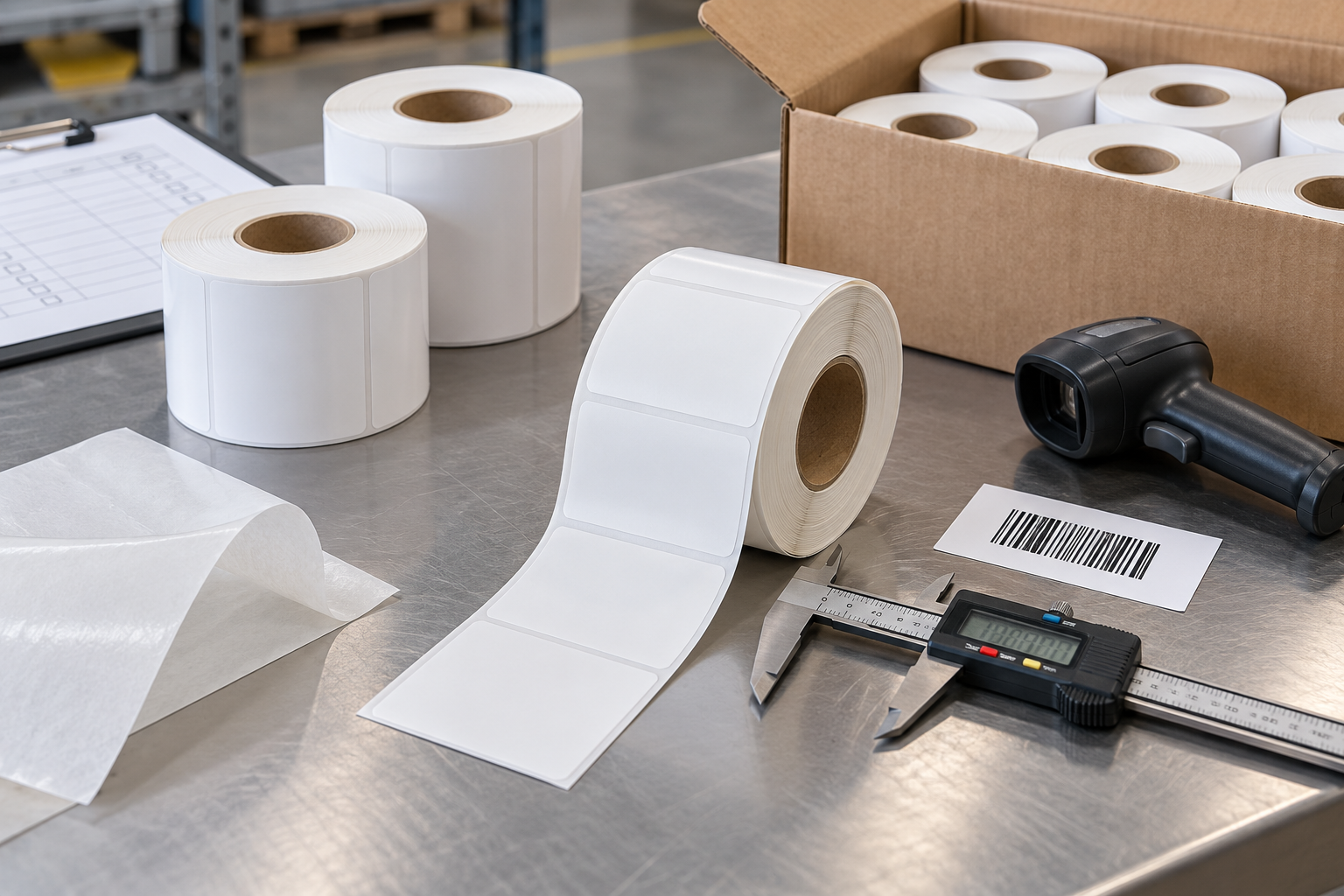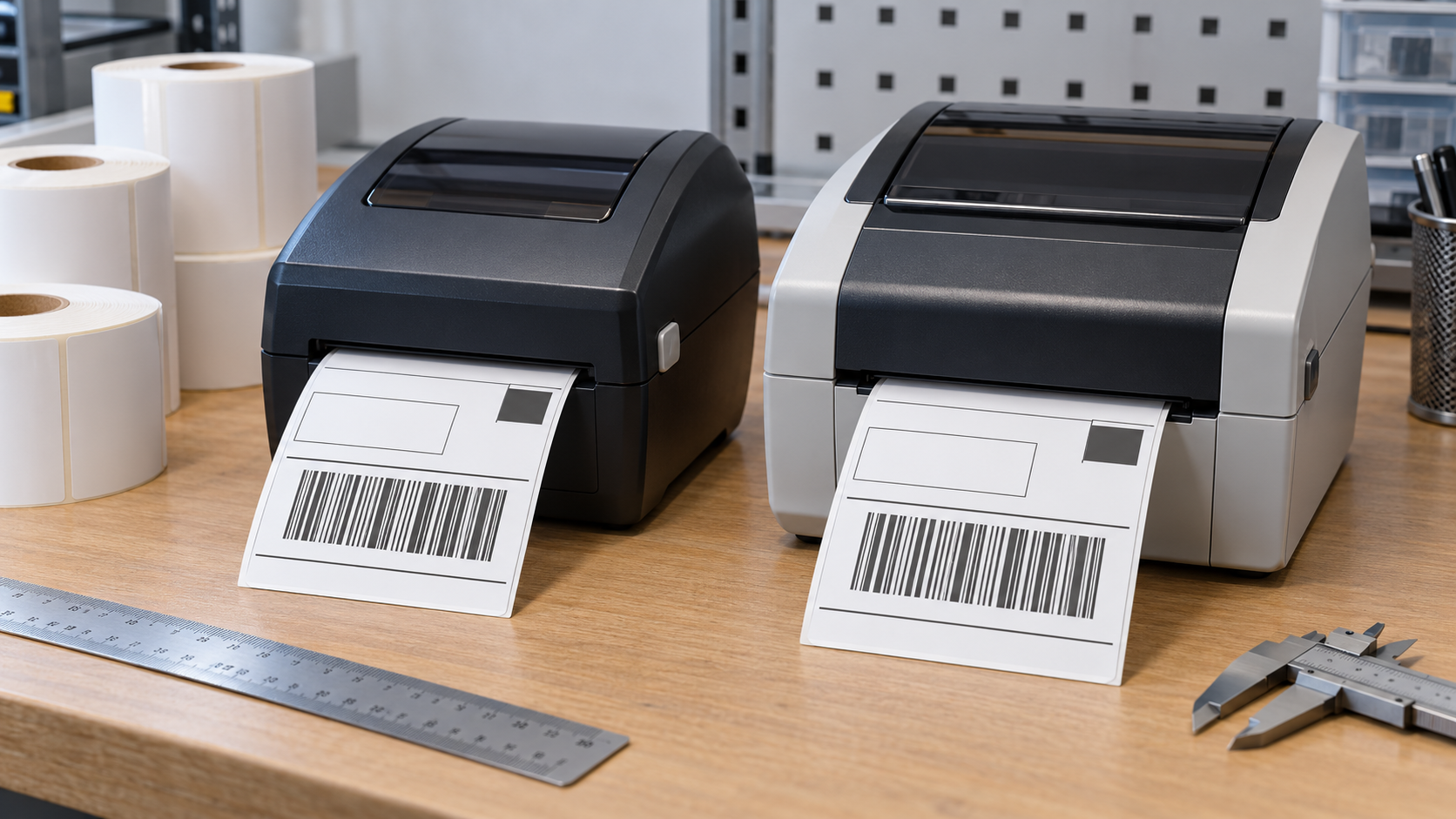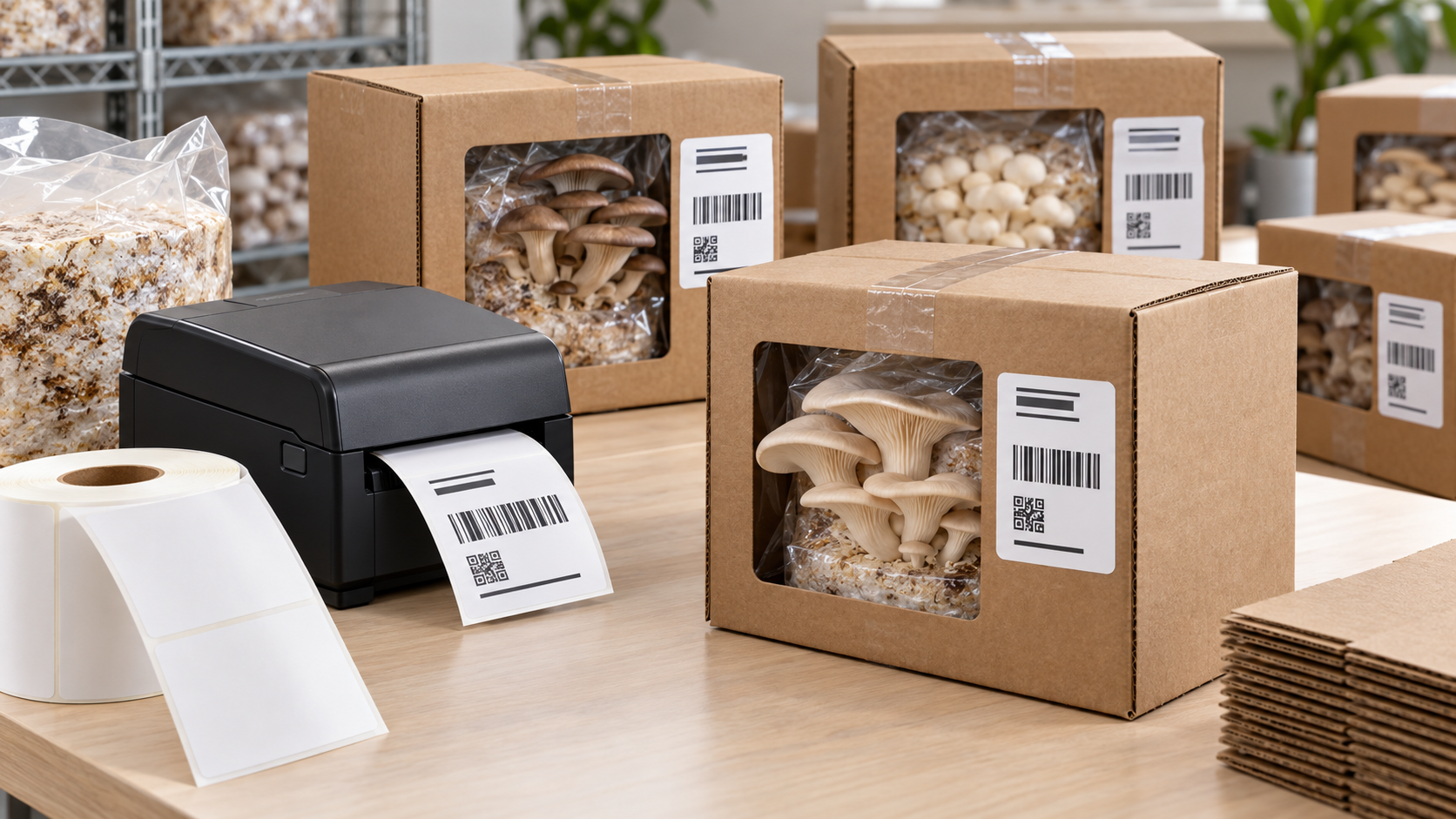
Buying thermal labels in bulk can reduce unit costs, simplify inventory planning, and help a business avoid running out of essential supplies during busy periods. For ecommerce sellers, warehouses, retailers, manufacturers, and logistics companies, thermal labels are often used every day. A small purchasing mistake can therefore become a large operational problem when thousands of rolls or millions of labels are involved.
The challenge is that thermal labels are not all the same.
Two labels may look nearly identical but use different paper, adhesives, liners, cores, roll diameters, or thermal coatings. One may print smoothly in your thermal printer, while another may skip, curl, peel, or produce weak barcodes. A low-priced quotation can look attractive until the labels begin causing reprints, scanner failures, or printer downtime.
This is why bulk buyers should ask detailed questions before placing a large thermal label order.
A professional thermal label supplier should be able to explain the label specification, confirm printer compatibility, discuss the application environment, provide samples when necessary, and clearly describe production and quality control standards.
Before you buy thermal labels in bulk, use the following questions to reduce risk and make a more informed purchasing decision.
What Thermal Label Size Do I Actually Need?
The first question seems simple, but label size errors are common.
You should confirm both label width and label height before requesting a quotation.
For example:
4 x 6 inches
2 x 1 inch
3 x 2 inches
1 x 2 inches
Do not assume that a printer model automatically determines one label size.
Many thermal printers support several label dimensions.
Start by asking:
What information will be printed on the label?
A shipping label may need space for:
- Customer address
- Carrier barcode
- Tracking information
- Routing data
- Service level information
A warehouse label may only need:
- SKU
- Barcode
- Bin location
A retail price label may need:
- Product name
- Price
- Small barcode
The correct thermal label size should provide enough print area without creating unnecessary material waste.
Before buying thermal labels in bulk, print your actual label design at full size and test it.
Check whether the barcode is readable.
Check whether the text is too small.
Check whether the label fits the package, bin, bottle, shelf, or product.
A paper template can also help. Cut a blank sheet to the proposed label dimensions and place it on the real application surface.
This small test may prevent a very large purchasing mistake.
Are the Thermal Labels Compatible With My Printer?
Printer compatibility should be one of the first questions you ask a thermal label supplier.
Do not only say:
“I need thermal labels.”
Instead, provide the exact printer brand and model.
For example:
Brother QL series
Zebra desktop printers
Zebra industrial printers
DYMO LabelWriter models
Rollo printers
Jadens printers
Other direct thermal printers
The supplier needs to understand how your printer loads and detects label media.
Ask:
Have you supplied labels for my exact printer model before?
The answer can help identify possible compatibility issues.
A label may have the correct width but still fail because of:
- Wrong core size
- Excessive roll diameter
- Incorrect label gap
- Wrong black mark position
- Incorrect roll direction
- Unsupported media type
Betckey, for example, supplies thermal label options compatible with major printer categories such as Brother, Zebra, and DYMO. For bulk orders, identifying the exact printer model helps narrow down the correct label structure.
When buying for several warehouses or departments, list every printer model being used.
Do not assume one roll will fit all printers.
Are These Direct Thermal or Thermal Transfer Labels?
Ask the supplier to clearly identify the printing method.
Direct thermal labels and thermal transfer labels are different products.
Direct thermal labels contain a heat-sensitive surface coating. The thermal printer’s printhead creates the image through heat.
No ribbon is required.
Direct thermal labels are widely used for:
Shipping
Warehouse identification
Short-term inventory
Retail labels
Barcode labels
Thermal transfer printing uses a ribbon.
Heat transfers material from the ribbon to the label surface.
Before placing a bulk order, ask:
Are these labels designed for direct thermal printing or thermal transfer printing?
Using the wrong media may result in blank labels or poor print quality.
You should also check your printer settings.
Some printers support both direct thermal and thermal transfer modes. The printer may need to be configured correctly for the media being used.
For general shipping and ecommerce applications, direct thermal labels are often selected because they are easy to use and do not require ink, toner, or a ribbon.
However, the best printing method depends on the label lifespan and environment.
A supplier should understand your application instead of recommending the same material for every customer.
What Material Are the Thermal Labels Made From?
The next important question is:
What is the label face material?
The face material is the printable surface of the label.
Common categories include paper and synthetic materials.
Direct Thermal Paper
Direct thermal paper is commonly used for shipping, inventory, warehouse, and retail applications.
It is typically:
- Cost-effective
- Easy to print
- Suitable for high-volume use
- Available in many sizes
Paper labels can be a practical choice for short-term applications.
For example, a shipping label may only need to remain readable during order processing and delivery.
In that situation, using a premium synthetic material may not be necessary.
Synthetic Thermal Materials
Synthetic materials may provide better resistance to:
Water
Oil
Tearing
Moisture
Repeated handling
They can be useful for:
Plastic containers
Cold environments
Laboratories
Cosmetics
Soap products
Reusable bins
Humid warehouses
Before buying in bulk, tell the supplier about the real environment.
Do not simply ask:
“Is this label waterproof?”
Instead, ask more detailed questions:
Can the label handle light water splashes?
Can it handle oil contact?
Will the printed image remain readable in high humidity?
Does the label tear easily?
Will the container be refrigerated?
Will the label be handled repeatedly?
A good supplier should explain what the material is designed to handle.
Betckey’s product range, for example, includes standard paper labels and more durable removable thermal label options designed for improved resistance to water, oil, and tearing.
The goal is to choose a material that matches the application without paying for unnecessary performance.
What Type of Adhesive Is Used?
Adhesive is one of the most important parts of a thermal label.
Ask the supplier:
Is the adhesive permanent or removable?
Permanent Adhesive
Permanent adhesive is commonly used for:
Shipping boxes
Product packaging
Inventory labels
Warehouse cartons
Logistics applications
The label is designed to create a stronger, longer-term bond.
However, permanent adhesive does not guarantee perfect adhesion to every surface.
Adhesive performance can change depending on:
Surface texture
Dust
Oil
Moisture
Temperature
Plastic type
This is why buyers should describe the application surface clearly.
Removable Adhesive
Removable adhesive is designed for applications where the label may need to be removed later.
Common uses include:
Reusable containers
Storage bins
Temporary shelf labels
Short-term inventory identification
Food containers
Retail displays
Ask:
Will the label remove cleanly after the expected use period?
This is important because removal performance can change over time.
A label that removes easily after one hour may behave differently after two months.
For removable labels, request samples and test them on the actual surface.
Betckey offers both permanent and removable label options, allowing bulk buyers to select adhesive based on the workflow instead of forcing one adhesive type into every application.
What Surface Will the Label Stick To?
A thermal label supplier should ask about the application surface.
If the supplier does not ask, you should provide the information yourself.
Common surfaces include:
Corrugated cardboard
Coated cardboard
Plastic
Glass
Metal
Paper bags
Poly mailers
Flexible plastic packaging
The same adhesive may behave differently on each surface.
Cardboard
Shipping cartons are a common application.
However, cardboard quality varies.
Some boxes are:
Rough
Dusty
Recycled
Coated
Highly textured
A label that sticks well to a smooth test board may perform differently on recycled corrugated boxes.
Plastic
Plastic can be more complicated.
Different plastic materials have different surface characteristics.
Reusable warehouse bins, bottles, zip bags, and poly mailers may all require different adhesion performance.
Flexible plastic can also bend and wrinkle.
Ask the supplier whether the label has been tested on a similar material.
Glass
Glass is usually smooth, but the buyer still needs to decide whether permanent or removable adhesion is preferred.
Reusable bottles and jars may benefit from removable labels.
Metal
Metal surfaces can be:
Cold
Painted
Oily
Smooth
Textured
For industrial use, describe the application carefully.
The more information you provide, the better the supplier can evaluate the adhesive requirement.
At What Temperature Will the Labels Be Applied?
Many bulk buyers discuss storage temperature but forget about application temperature.
These are not the same thing.
Application temperature is the temperature of the label and surface when the label is first applied.
Storage or service temperature is the temperature the label experiences after application.
For example:
A label applied to a room-temperature carton and later moved into a refrigerator may perform differently from a label applied directly to a frozen container.
Ask:
What is the minimum application temperature for this adhesive?
Also explain:
Whether the surface is cold
Whether condensation is present
Whether the label enters a freezer
Whether temperature changes rapidly
If your business works with refrigerated goods or cold-storage environments, this question is especially important.
Incorrect adhesive selection can cause labels to lift at the corners or fall off completely.
What Core Size Does the Roll Use?
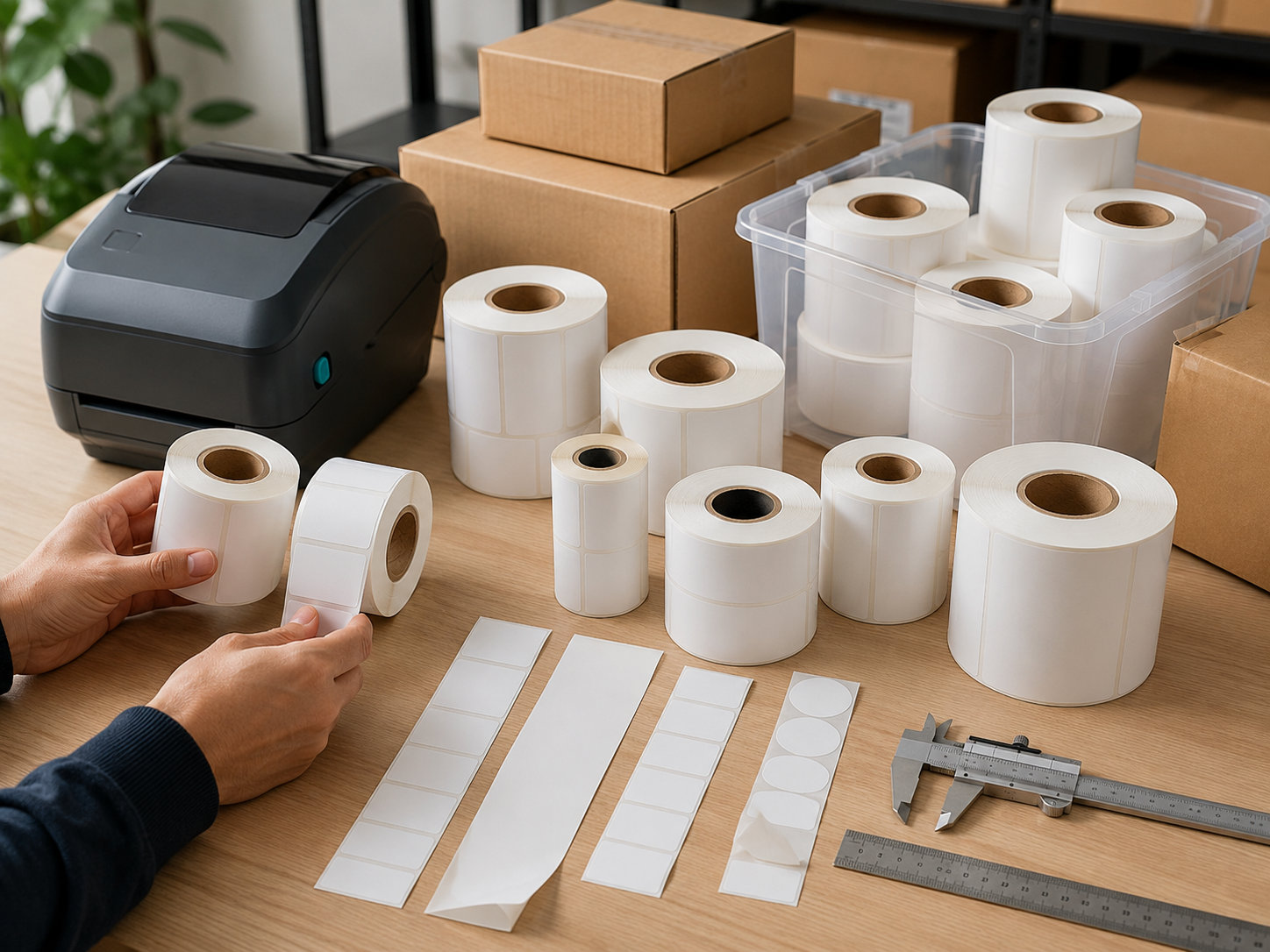
Core size is the diameter of the tube in the center of the thermal label roll.
Ask:
What is the roll core size?
Common label core sizes can include:
0.75-inch core
1-inch core
1.5-inch core
3-inch core
The correct size depends on the printer and application.
Many desktop thermal printers use smaller label rolls.
Industrial printers often use larger rolls with larger cores.
However, you should always confirm the printer specification.
A 3-inch core label roll will not fit a printer designed for a small desktop roll.
Do not confuse core size with label roll diameter.
They are different measurements.
Before placing a bulk order, ask the supplier to include core size in the quotation or product specification.
What Is the Maximum Roll Outer Diameter?
Roll outer diameter is another specification that bulk buyers often overlook.
Ask:
What is the finished roll outer diameter?
A thermal label roll may have the correct label size and core size but still be too large to fit inside the printer.
This is especially important when buying rolls with high label counts.
For example, a supplier may offer:
250 labels per roll
500 labels per roll
1,000 labels per roll
3,000 labels per roll
More labels per roll can reduce roll changes.
However, a larger roll requires more physical space.
Desktop printers may have limited internal roll capacity.
Some printers support externally fed labels, while others are designed for internal rolls.
Before ordering, compare:
Printer maximum media roll diameter
Supplier finished roll diameter
For industrial applications, larger rolls may improve productivity because operators replace media less frequently.
For compact desktop printers, smaller rolls may be more practical.
How Many Labels Are on Each Roll?
Ask the supplier to confirm the exact label count per roll.
Do not assume that all rolls contain the same quantity.
The label count affects:
Price comparisons
Storage planning
Printer roll changes
Packaging quantity
Freight calculations
Suppose Supplier A offers 500 labels per roll.
Supplier B offers 350 labels per roll.
Comparing only the price per roll can be misleading.
Calculate the cost per label or cost per thousand labels.
Ask:
Is the stated quantity guaranteed or approximate?
For bulk purchasing, quantity consistency matters.
If your company uses thousands of rolls, small differences in label count can affect inventory planning.
The quotation should clearly show:
Labels per roll
Rolls per case
Cases per pallet, if applicable
Total labels ordered
How Are the Labels Detected by the Printer?
Thermal printers use different sensing methods.
Ask:
Are these gap labels, black mark labels, notched labels, or continuous media?
Gap Labels
Die-cut labels often have a gap between each label.
The printer sensor detects the gap and positions each label correctly.
Black Mark Labels
A black mark is printed on the liner or media.
The printer detects this mark to control feeding.
Continuous Labels
Continuous thermal labels do not use a fixed die-cut label length.
The printer feeds continuous material and cuts or tears it according to the print setup.
Incorrect media sensing specifications can cause:
Skipped labels
Blank labels feeding
Printing between labels
Media-out errors
Incorrect alignment
When changing thermal label suppliers, ask whether the new media uses the same sensing structure as your current labels.
For a custom bulk order, the supplier may ask for a sample roll or detailed media specification.
Providing a photo of the existing label roll, liner, and printer loading method can reduce mistakes.
What Is the Label Gap Size?
For die-cut labels, the gap size can affect printer detection.
Ask:
What is the gap between labels?
Do not assume the label size alone is enough.
For example, a 2 x 1 inch label specification describes the face size.
It does not automatically describe:
Gap size
Liner width
Edge margin
Sensor mark
Some printers are more sensitive to media structure than others.
If you currently use labels that print reliably, consider providing the supplier with a sample.
The supplier can evaluate:
Label dimensions
Gap
Liner
Core
Roll direction
For large custom orders, matching an existing successful sample can reduce compatibility risk.
What Is the Roll Unwind Direction?
Roll unwind direction describes how the labels are oriented as they come off the roll.
This may also be called roll direction or wind direction.
Ask:
Which way do the labels unwind?
For many simple desktop printing applications, the printer determines how the roll is loaded.
For automatic label applicators, production lines, or industrial printing systems, unwind direction can be critical.
A wrong roll direction may require rewinding the entire roll or may make it unusable in automated equipment.
For preprinted labels, orientation can also matter.
If a logo or fixed text is already printed on the label, confirm:
Top edge
Bottom edge
Leading edge
Roll direction
When possible, include a diagram or approved sample in the purchase order.
Can I Get Samples Before Placing a Bulk Order?
One of the most important questions is:
Can I test samples before placing the full order?
A sample can help confirm:
Printer compatibility
Print quality
Barcode scanning
Adhesion
Removal
Water resistance
Roll feeding
For standard stock labels, a supplier may provide an existing roll sample.
For custom products, a supplier may provide material samples, similar sizes, or a trial production option depending on the project.
When testing, do not only print one label.
Run a realistic test.
Print dozens or hundreds of labels continuously if possible.
Check for:
Skipped labels
Feeding problems
Curling
Misalignment
Weak print
Barcode failures
Then apply labels to real surfaces.
Do not test only on a clean office desk.
If your labels are normally applied to warehouse cartons, use warehouse cartons.
If labels are used on plastic bins, test the exact bin material.
A proper sample test can prevent a very expensive bulk purchasing mistake.
How Should I Test Barcode Print Quality?
Bulk thermal label buyers should always test real barcode performance.
Ask the supplier about print surface consistency, but also perform your own operational test.
Print your actual:
UPC barcode
Code 128 barcode
QR code
SKU barcode
Shipping label
Use the printer settings used in daily operations.
Then scan the label with:
Warehouse scanners
Handheld scanners
Mobile devices
Carrier scanning equipment, when possible
Check whether the barcode scans quickly.
A barcode may look acceptable to the human eye but still perform poorly in a scanner.
Thermal label print quality can be affected by:
Thermal coating
Print darkness
Print speed
Printhead condition
Label surface
Barcode size
Do not automatically increase printer darkness to the maximum.
Excessive heat can cause barcode lines to become thicker or less defined.
The goal is a sharp, high-contrast print.
What Quality Control Does the Supplier Use?
Before buying thermal labels in bulk, ask:
How do you control product quality?
This is especially important for repeated wholesale orders.
Ask whether the supplier checks:
Label size
Die-cut position
Roll quantity
Core size
Roll tension
Adhesive coating
Print sensitivity
Packaging
Die-cutting consistency matters.
If the die cut is too deep, it may damage the liner.
If the die cut is incomplete, labels may be difficult to peel.
Roll tension also matters.
A roll that is too tight may create pressure problems.
A roll that is too loose may become uneven or damaged.
Adhesive bleed can cause labels to stick together or leave residue inside the printer.
For long-term purchasing, consistency is often more important than receiving one perfect sample.
Ask:
How do you ensure that future production batches match the approved product?
Betckey operates with its own factory supply capabilities, allowing closer control over label converting, custom specifications, and repeated wholesale production.
For buyers with ongoing demand, supplier consistency should be evaluated as part of the total cost.
Is the Thermal Paper BPA-Free or Phenol-Free?
Depending on your business requirements and target market, you may want to ask about thermal paper chemistry.
Ask:
Is the thermal paper BPA-free?
You may also ask:
Do you offer phenol-free thermal label options?
This can be relevant for companies with internal material policies, retailer requirements, or specific customer standards.
Do not assume all thermal paper uses the same chemical formulation.
If material compliance is important to your business, ask the supplier for the appropriate product information or documentation.
The required specification should be discussed before production.
Changing material requirements after a bulk order has been completed can be expensive.
Can the Supplier Provide Custom Sizes and Materials?
If your business is growing, ask whether the supplier supports customization.
You may not need custom labels today, but future projects may require:
Special dimensions
Round labels
Colored labels
Removable adhesive
Water-resistant materials
Special roll counts
Preprinted labels
Working with a supplier that provides both stock and custom products can simplify purchasing.
Betckey’s range includes permanent labels, removable labels, colored labels, round labels, removable water-resistant options, and custom thermal label solutions.
For businesses operating multiple warehouses or product categories, a broader supplier range can reduce the number of vendors needed.
Ask:
What is the minimum order quantity for custom thermal labels?
Also ask:
Is there a tooling fee?
Is a custom die required?
Can existing die sizes be used?
Are sample costs refundable after a bulk order?
These details can affect the total project cost.
What Is the Minimum Order Quantity?
MOQ means minimum order quantity.
Ask the supplier:
What is your MOQ for this thermal label?
Stock products and custom products may have different minimums.
A standard 4 x 6 shipping label may be available in smaller wholesale quantities.
A custom-size label may require a larger order because the supplier needs to:
Prepare materials
Set up machinery
Create tooling
Adjust die-cut equipment
Package a special batch
Do not only ask whether a supplier accepts your order quantity.
Ask how order volume affects pricing.
For example:
What is the price at 100 rolls?
What is the price at 500 rolls?
What is the price at 1,000 rolls?
What is the price at 5,000 rolls?
Understanding quantity breaks can help you plan purchasing more efficiently.
However, do not buy excessive inventory only to reach the lowest unit price.
Consider storage space and actual label consumption.
What Is the Real Price Per Label?
Bulk buyers should compare quotations carefully.
Ask:
What is the price per thousand labels?
This is often more useful than comparing only price per roll.
One supplier may quote a lower roll price but provide fewer labels per roll.
You should compare:
Label size
Material
Adhesive
Labels per roll
Core size
Packaging
Total quantity
Freight
For example, a synthetic removable label should not be compared directly with a basic paper permanent label.
They are different products.
A quotation that appears more expensive may use:
Better material
Different adhesive
Higher label count
More protective packaging
Ask the supplier to provide a clear product specification with the price.
The cheapest label is not always the lowest-cost solution.
If low-quality labels cause:
Reprints
Scanner failures
Printer jams
Peeling shipping labels
Warehouse relabeling
The operational cost may be much higher.
Does the Price Include Shipping or Freight?
Always confirm the shipping terms.
Ask:
Does the quoted price include freight?
For a large thermal label order, shipping costs can be significant because labels are dense and heavy.
Compare quotations using the total landed cost when possible.
Ask about:
Shipping method
Delivery destination
Freight charges
Pallet requirements
Customs responsibility for international orders
Import duties, when applicable
A low factory price may become less competitive after logistics costs are added.
For regular wholesale purchasing, discuss shipment planning with the supplier.
Consolidated shipments or larger planned orders may improve freight efficiency.
However, the best solution depends on your inventory turnover and storage capacity.
What Is the Production Lead Time?
Ask:
How long does production take?
Do not confuse production time with delivery time.
The total timeline may include:
Order confirmation
Deposit or payment
Artwork approval
Material preparation
Production
Quality inspection
Packing
Shipping
Standard stock labels may ship more quickly.
Custom thermal labels may require additional production time.
For seasonal businesses, lead time is especially important.
If your order volume increases during:
Black Friday
Holiday shopping
Back-to-school season
Prime Day
Peak warehouse periods
Plan label purchases early.
Ask whether production lead times change during busy periods.
Also ask:
How early should I place repeat orders?
A good supplier can help bulk buyers estimate reorder timing based on manufacturing and shipping requirements.
Can the Supplier Maintain the Same Specification for Repeat Orders?
For businesses buying thermal labels repeatedly, consistency is critical.
Ask:
Will repeat orders use the same material and adhesive specification?
A label may perform well during the first shipment.
Problems can occur if future batches change unexpectedly.
For example:
Different thermal coating
Different adhesive
Different liner
Different roll tension
These changes may affect printer performance.
For important applications, establish an approved product specification.
This may include:
Label dimensions
Material
Adhesive
Core size
Roll count
Roll direction
Packaging
Ask the supplier to reference the same product code or specification on repeat orders.
For custom products, keep approved samples when possible.
This makes it easier to compare future production.
What Packaging Is Used for Bulk Thermal Labels?
Bulk label packaging affects storage and transportation.
Ask:
How are the rolls packed?
Thermal labels can be affected by:
Heat
Moisture
Sunlight
Pressure
Poor storage
Ask whether rolls are:
Individually bagged
Packed in protective bags
Placed in cartons
Palletized for large shipments
For long-term storage, protect thermal labels from excessive heat and direct light.
Betckey has previously recommended controlled storage conditions around 25°C or 77°F and approximately 50–60% relative humidity for label storage where possible.
Rolls should also be stored carefully to avoid unnecessary pressure and deformation.
If your company receives full pallets, ask the supplier about recommended warehouse storage.
What After-Sales Support Does the Supplier Provide?
Finally, ask:
What happens if I have a problem after receiving the labels?
A reliable supplier should have a clear process for reviewing quality concerns.
Ask about:
Response time
Replacement policy
Quality claims
Sample retention
Technical support
If labels are skipping in a printer, the cause may involve:
Media
Printer calibration
Sensor settings
Print settings
Loading method
A supplier with thermal label experience may help identify the problem more quickly.
Betckey supports customers across multiple label categories and major printer compatibility groups, with after-sales support available for product and compatibility questions.
For bulk buyers, supplier service matters because a delayed solution can interrupt warehouse or shipping operations.
Final Checklist Before Buying Thermal Labels in Bulk
Before approving a bulk thermal label order, confirm the following:
Label size
Printer brand and model
Direct thermal or thermal transfer
Paper or synthetic material
Permanent or removable adhesive
Application surface
Application temperature
Storage environment
Core size
Roll outer diameter
Labels per roll
Gap, black mark, or continuous media
Roll unwind direction
Barcode print test
Sample approval
Order quantity
MOQ
Unit price
Freight terms
Production lead time
Packaging
Repeat order specification
After-sales support
If any of these details are unclear, ask before confirming the order.
Thermal labels are consumable products, but they play an important role in shipping, barcode scanning, inventory control, and warehouse operations.
A small label problem can create a large workflow problem.
The best bulk purchasing decision is not simply to find the lowest price.
It is to find a label that fits the printer, prints clearly, adheres correctly, survives the required environment, and remains consistent across repeated orders.
For businesses looking for stock or custom thermal label solutions, Betckey provides a broad range of permanent, removable, colored, round, and more durable removable thermal label options. With products designed around Brother, Zebra, DYMO, and other common thermal printing applications, as well as factory-based custom supply capabilities, Betckey can support both standard and wholesale thermal label purchasing requirements.
Ask detailed questions before buying.
Test the labels.
Confirm the specification.
Then place the bulk order with greater confidence.
FAQs About Buying Thermal Labels in Bulk
1. Is it cheaper to buy thermal labels in bulk?
Buying thermal labels in bulk can reduce the price per label because larger orders may improve manufacturing, packaging, and purchasing efficiency. However, buyers should compare the price per thousand labels instead of only the price per roll. Label material, adhesive, roll quantity, core size, and freight should also be considered. Buying a large quantity of the wrong label can be more expensive than paying slightly more for a properly tested product.
2. Should I request thermal label samples before placing a bulk order?
Yes. Samples are strongly recommended, especially when changing suppliers, using a new label size, labeling plastic or cold surfaces, or ordering custom thermal labels. Test printer feeding, barcode scanning, print quality, adhesion, and removal performance. Use the actual printer and application surface from your normal workflow.
3. What information should I give a thermal label supplier for a bulk quote?
Provide the label width and height, printer brand and model, printing method, material preference, adhesive type, application surface, core size, labels per roll, total quantity, and delivery destination. You should also explain whether the labels will be exposed to moisture, oil, cold, or frequent handling. The more complete the application information is, the easier it is for the supplier to recommend a suitable thermal label specification.